Biosafety · 8 min read · October 12, 2026
Biosafety Cabinet Certification: What to Expect
When Class II cabinets need certification, what the NSF/ANSI 49 field tests cover, how long it takes, and how to prepare your lab.
Why biosafety cabinets need certification
A biological safety cabinet (BSC) protects three things at once: the person working at it, the work inside it, and the room around it. It does that through a carefully balanced pattern of inflow at the front opening, HEPA-filtered downflow over the work surface and filtered exhaust. If any part of that balance drifts, protection can fail without any visible sign.
Field certification is the only reliable way to confirm a cabinet still performs as designed. That's why biosafety guidance, including the CDC and NIH publication Biosafety in Microbiological and Biomedical Laboratories (BMBL), calls for cabinets to be tested and certified in place.
When certification is needed
Class II cabinets are generally field-certified in four situations. Your institutional biosafety committee or quality system may require more frequent testing, for example every six months for cabinets used with higher-risk agents or in sterile compounding.
- At installation, before the cabinet is first used.
- After the cabinet is moved, even within the same room.
- After repairs or maintenance, including HEPA filter or motor replacement.
- At least annually as routine recertification.
Understanding cabinet classes and types
Class I cabinets protect the user and the room but not the product. Class II cabinets, the most common in research and clinical labs, protect all three. Within Class II, types A1, A2, B1, B2 and C1 differ in how much air is recirculated versus exhausted and in how they connect to the building's exhaust system. Class III cabinets are gas-tight glove boxes used for the highest-risk work.
The type matters for certification. Canopy-connected Type A cabinets and hard-ducted Type B cabinets have different exhaust checks and alarm tests, so give the certifier the manufacturer, model and serial number of every cabinet when you request a quote.
What the field tests cover
NSF/ANSI 49 is the standard most commonly referenced for BSC design and field certification in the U.S. A typical certification visit includes the following tests.
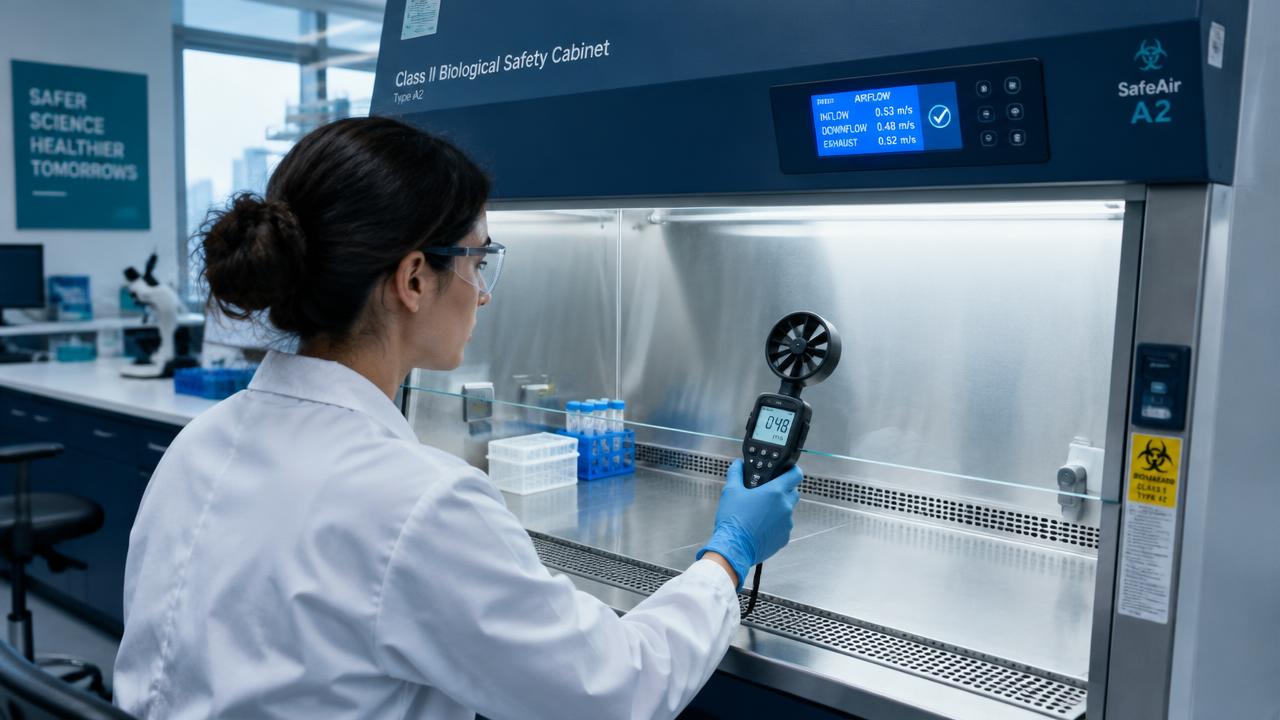
- Inflow velocity: confirms enough air is drawn in at the front opening to protect the operator.
- Downflow velocity: confirms filtered air moves evenly down across the work surface.
- HEPA filter leak testing: scans the supply and exhaust filters for leaks using an aerosol challenge.
- Airflow smoke patterns: shows visually that air moves in the right direction at the opening and inside the work area.
- Site installation checks: alarms, exhaust connection and, for canopy or ducted units, exhaust performance.
- Optional tests: lighting, noise, vibration, electrical leakage and UV lamp intensity where present.
How long a certification takes
For a routine recertification with no repairs, plan on one to two hours per cabinet. Initial certifications, cabinets that need adjustment, and filter replacements take longer. Ducted cabinets that depend on building exhaust may need coordination with facilities staff. Ask your certifier for an estimate per cabinet so you can schedule work around it.
How to prepare your lab
A little preparation keeps the visit short and safe for everyone.
- Clear the work surface and remove supplies stored inside the cabinet.
- Surface-disinfect the interior before the technician arrives.
- Schedule gaseous decontamination in advance if internals will be opened, such as for filter replacement.
- Tell the certifier what agents are handled in each cabinet.
- Make sure the area in front of the cabinet is clear and the room's HVAC is running normally.
Choosing a certifier
Ask whether the technician is accredited for NSF/ANSI 49 field certification, and ask to see the credential. Confirm the certifier's instruments carry current calibration, and ask for a sample report. A good report lists each test, the measured values, the acceptance criteria and a clear pass or fail for each cabinet, and the cabinet should get a dated certification label.
On LabSource Network, credentials we have checked are marked verified and credentials the provider reports are labeled as such, so you know exactly what was confirmed.
Sources and further reading
This article is general guidance, not compliance advice. Standards are revised over time; confirm the current edition and the requirements that apply to your facility with your quality team.